
CSS Syllabus 2026 & 2027: Complete FPSC Subjects + PDF
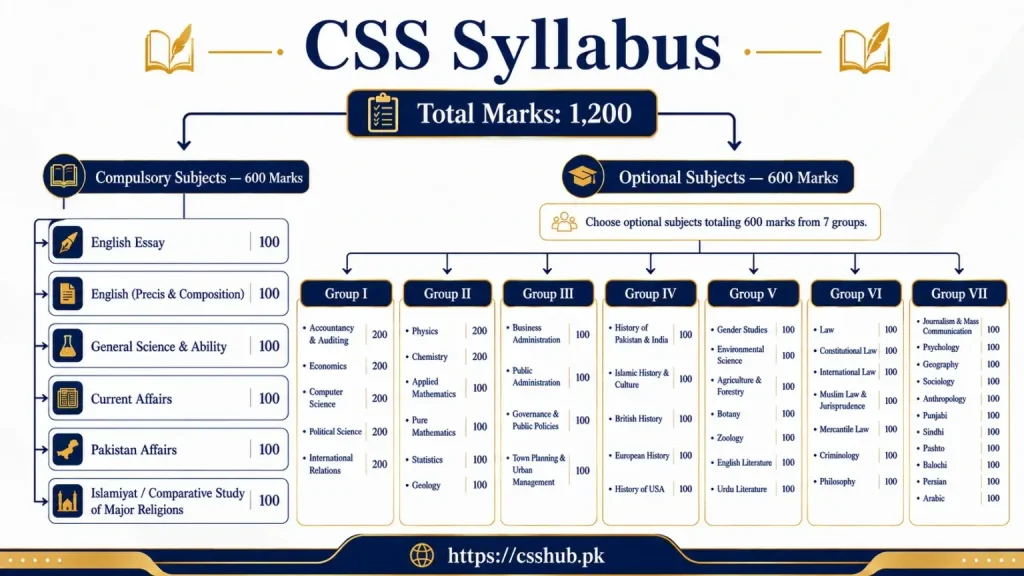
The CSS syllabus 2026 and 2027 consists of 1,200 written marks, including six compulsory papers worth 600 marks and optional subjects worth another 600 marks selected from seven FPSC groups. The current syllabus framework has remained applicable since CE-2016, and FPSC has not announced a separate revised syllabus for CSS 2027.

The confusion usually starts with one simple question:
What exactly am I supposed to study?
The good news is that the syllabus becomes much easier once you stop looking at it as one giant document.
Here you will find the complete FPSC CSS Syllabus, the marks distribution, optional subject group rules, paper pattern and how to use the syllabus to build a practical preparation plan.

CSS Written Examination Structure
The CSS written exam carries 1200 marks, divided equally between compulsory and optional papers.
- Compulsory papers worth 600 marks
- Optional subjects carrying 600 marks.
Each paper is 3 hours long, and most papers are descriptive, meaning your writing, structure, and clarity matter more than short memorized facts. This matters because CSS doesn’t test how much you’ve read. It tests how well you can understand, connect, and explain.
Where to Download the Official FPSC CSS Syllabus PDF
Use the official syllabus hosted by FPSC rather than depending entirely on academy notes or screenshots shared in WhatsApp groups.
Source: Federal Public Service Commission — Revised Syllabi for CSS Competitive Examination, CE-2016 and onwards.
Subjects carrying 200 marks are divided into two separate papers of 100 marks each. Subjects carrying 100 marks have one paper. The official scheme also provides rules for the language of answers and the objective portion of different papers.
Has the CSS Syllabus Changed for 2027?
FPSC’s official document is titled “Revised Syllabi for CSS Competitive Examination, CE-2016”, and it applies to CE-2016 and onwards. There is no separate official FPSC document announcing a completely revised syllabus specifically for CSS 2027.
So, unless FPSC issues a new notification, candidates preparing for CSS 2027 should continue following the existing official scheme and subject outlines.
Be careful with the websites using phrases such as “new revised CSS 2027 Syllabus” without linking to an actual FPSC notification. Updating the year in an article title doesn’t mean FPSC has changed the syllabus.
CSS Written Exam Syllabus and MPT Syllabus Are Different
The syllabus discussed here is for the 1200-mark written CSS examination.
The MCQ based preliminary test, or MPT, has a separate syllabus covering English, Urdu, Islamic Studies or Civics and Ethics, General Abilities, Current Affairs, Pakistan Affairs, and Everyday Science. FPSC publishes the MPT syllabus separately.
Passing the MPT test makes you eligible to apply for the written examination, but MPT marks are not added to the 1200 written CSS examination marks.
CSS Compulsory Subjects 2027 — 600 Marks
Every candidate must attempt all six compulsory papers. Each subject carries 100 marks, bringing the compulsory total to 600.
|
# |
Subjects |
Marks |
|---|---|---|
|
1 |
100 |
|
|
2 |
100 |
|
|
3 |
100 |
|
|
4 |
100 |
|
|
5 |
100 |
|
|
6 |
Islamic Studies OR Comparative Study of Major Religions (For Non-Muslims) |
100 |
|
Total |
|
600 |
The compulsory papers test more than your ability to memorize. They examine
- How clearly do you think?
- How well do you understand an issue?
- Your ability to build a focused argument under time pressure.
English Essay – 100 Marks
The English Essay paper test your ability to:
- Understand a topic
- Develop a central argument
- Organize ideas
- Express them in a clear English language.
Expectations of FPSC from the candidate:
- Research based knowledge
- Logical treatment of the topic
- Suitable structure
- Strong written expression
The paper isn’t simply a test of difficult vocabulary. A simple controlled argument is far better than decorative language that says very little.
English Precis and Composition – 100 Marks
This paper covers:
- Precis writing
- Reading comprehension
- Grammar and vocabulary
- Sentence correction
- Grouping of words
- Pairs of words
- Urdu to English translation
The official distribution gives 20 marks each to precis writing, comprehension, and grammar and vocabulary. The remaining marks cover sentence correction, words grouping, pair of words, and translation.
General Science and Ability – 100 Marks
General Science and Ability is divided into:
- General Science — 60 marks
- General Ability — 40 marks
The science section includes:
- Physical science
- Biological science
- Environmental science
- Food science
- Information technology
The ability section covers:
- Basic mathematics
- Quantitative reasoning
- Logical reasoning
- Analytical ability
- Mental abilities
Current Affairs — 100 Marks
The official Current Affairs syllabus is divided into:
- Pakistan’s domestic affairs — 20 marks
- Pakistan’s external affairs — 40 marks
- Global issues — 40 marks
This paper changes in practice every year because the syllabus provides broad areas.
While questions are connected to current
- Political
- Economic
- Diplomatic
- Environmental
- Security developments
Pakistan Affairs — 100 Marks
Pakistan Affairs covers the country’s
- Ideological foundations
- Political development
- Constitutional debates
- Economy
- Society
- Security
- Foreign relations
- Regional challenges
- Historical development
The syllabus includes both historical and contemporary areas. So preparing only for the Pakistan Movement isn’t enough. Candidates must connect history with present-day political, economic, and social issues.
Islamic Studies or Comparative Study of Major Religions — 100 Marks
Muslim candidates normally take Islamic Studies.
Non-Muslim candidates may choose either:
- Islamic Studies, or
- Comparative Study of Major Religions
The paper may be answered in English or Urdu.
Key Point: Compulsory papers alone account for 50% of the written exam’s marks.
CSS Optional Subjects 2027 – 600 Marks
Optional subjects are where most candidates get confused.
You don’t simply choose any six subjects you like. You must select subjects carrying exactly 600 marks while following the limits placed on each group.
And here’s an important distinction you should know about the CSS optional subjects:
You may choose between four and six optional subjects, depending on whether you select 100 mark or 200 mark subjects. However, you will sit six optional papers because every 200 mark subject is divided into two papers.
CSS Optional Subject Selection Rules
| Group | Maximum Selection |
| Group I | One subject carrying 200 marks |
| Group II | Subject or subjects carrying a total of 200 marks |
| Group III | One subject carrying 100 marks |
| Group IV | One subject carrying 100 marks |
| Group V | One subject carrying 100 marks |
| Group VI | One subject carrying 100 marks |
| Group VII | One subject carrying 100 marks |
Because Group I contributes a maximum of 200 marks, Group II contributes a maximum of 200, and each remaining group contributes no more than 100, a valid 600-mark combination must use subjects from at least four groups. This follows directly from the official group limits.
Group-I
Group-II
Group-III
Group-IV
Group-V
Group-VI
Group-VII
Examples of Valid CSS Optional-Subject Combinations
Sometimes the rules make more sense when you see an actual combination.
Combination 1
- International Relations — 200
- Applied Mathematics — 100
- Statistics — 100
- Public Administration — 100
- Sociology — 100
Total: 600 marks
Combination 2
- Political Science — 200
- Chemistry — 200
- History of the USA — 100
- Criminology — 100
Total: 600 marks
Combination 3
- Economics — 200
- Public Administration — 100
- History of the USA — 100
- Gender Studies — 100
- Sociology — 100
Total: 600 marks
These are examples of combinations that satisfy the marks and group limits. They aren’t recommendations for every candidate.
How to Choose CSS Optional Subjects
You’ve probably heard someone say: “choose this subject, it’s very strong”
Be careful with this advice.
A subject that worked for one candidate may be completely wrong for you. Scoring pattern change, examiner change, and the way a candidate writes matters more than social media rumors suggest.
Consider these factors instead:
Your Academic Background
A familiar subject may reduce your preparation time, but familiarity alone isn’t enough. Compare your degree content with the actual FPSC syllabus and recent past papers.
Syllabus Length
Open the complete syllabus before selecting a subject. Some subjects look easy because their names are familiar, but their official outlines are much broader than expected.
Overlap with Other Papers
Useful overlap can save time.
International Relations and Political Science may support Current Affairs and Essay. History subjects can support Pakistan Affairs. Sociology, Gender Studies, and Criminology may help with social-issue essays.
But overlap shouldn’t be your only reason. You still need to prepare each paper according to its own syllabus and question style.
Availability of Reliable Material
Check whether you can find suitable books, past papers, notes, lectures, and updated examples.
Choosing an unusual subject with almost no reliable preparation material can turn a manageable syllabus into a daily struggle.
Your Answer-Writing Ability
Some subjects reward technical precision. Others require argument, analysis, examples, theories, diagrams, or numerical work.
Look at the past papers and ask yourself a simple question:
Can I realistically learn to answer these questions well?
Language and Paper Rules
The official FPSC scheme provides the following instructions:
- Papers in Urdu, Pakistani regional languages, Persian, and Arabic are answered in their respective languages.
- Translation questions are answered according to the instructions in the paper.
- Islamic Studies or Comparative Study of Major Religions may be answered in English or Urdu.
- Other papers are answered in English unless the question paper directs otherwise.
- A 200-mark subject has two papers of 100 marks each.
- A 100-mark subject has one paper.
- Each paper has a duration of three hours.
How to Use the CSS Syllabus Properly
Downloading the PDF is easy.
Using it properly is where the real work begins.
Turn Every Syllabus into a Checklist
Break each subject into main sections, topics, and subtopics. Tick a topic only when you have:
- Read it
- Make short notes
- Reviewed relevant current examples
- Practiced at least one question
This gives you a much more honest picture of your preparation.
Compare the Syllabus with Past Papers
The syllabus shows the boundaries. Past papers show how FPSC uses those boundaries.
Place past-paper questions under their relevant syllabus topics. You’ll quickly see which areas appear repeatedly and which topics require analytical rather than descriptive preparation.
Build a Preparation Sequence
Don’t study twelve papers randomly.
Start with English and one or two core compulsory papers. Then add optional subjects according to their length, difficulty and overlap.
A written plan is far more useful than waking up every morning and deciding what feels interesting.
Keep Dynamic Subjects Updated
Current Affairs, Pakistan Affairs, International Relations, Political Science, and several other papers can’t be prepared from old notes alone.
The syllabus gives you broad areas, but your facts, examples, data, policies, and case studies must remain current.
Common Mistakes Candidates Make With the CSS Syllabus
Candidates often lose months because they:
- Select optional subjects before reading the official outlines
- Follow “high scoring subject” rumors blindly
- Confuse between optional subjects
- Create an invalid group combination
- Collect books without mapping them to syllabus topics
- Ignore english until the final months
- Read widely but practice very few answers
- Use an old or incomplete third-party PDF
- Treat the MPT syllabus and written syllabus as the same thing
And may be the biggest mistake of all…
Trying to study everything connected to a subject.
You don’t need to know everything. You need to understand the areas FPSC has placed inside the syllabus and develop enough knowledge to answer analytical questions from those areas.
Final Words
The CSS syllabus looks intimidating because it puts your entire examination journey into one document.
But that’s also what makes it useful.
It tells you what’s compulsory, where you have a choice, how the marks are divided, and where your preparation should stop. Once you understand those boundaries, CSS preparation becomes less like wandering through a library and more like following a map.
Download the official syllabus. Build a valid optional combination. Match every topic with past papers. Then start working through it one section at a time.
Not everything at once.
Just the next topic. Then the next.
Where to Find the FPSC Official CSS Syllabus
The FPSC syllabus page hosts all subject PDFs and is the most reliable source from this page, you can download every subject’s full syllabus PDF, including detailed topic outlines for both compulsory and optional papers.
Frequently Asked Questions About the CSS Syllabus 2026 & 2027
CSS is not just about hard work, but about preparing smartly within the boundaries set by FPSC—and a clear grasp of the syllabus is the first step in that direction.