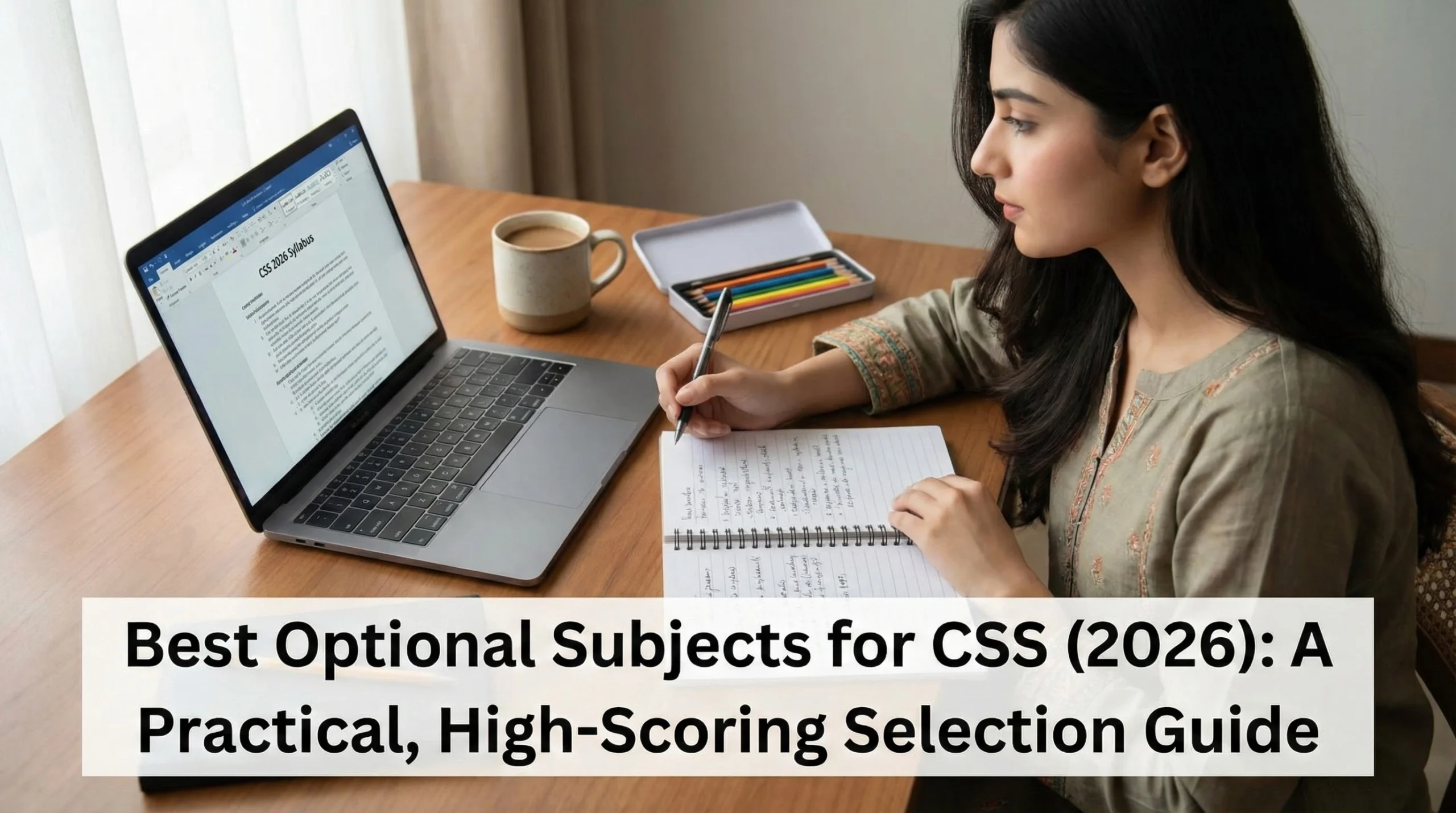
Best Optional Subjects for CSS (2026): A Practical, High-Scoring Selection Guide
Choosing optional subjects for CSS by FPSC feels… weirdly emotional.
Like, you know it’s “just subjects.” But it doesn’t behave like “just subjects,” does it? It sits on your chest a little.
Because one wrong combo and suddenly your study plan becomes that messy room you keep avoiding. Books everywhere. Notes half-done. Confidence leaking out daily.
And the worst part?
Everyone gives advice like they’re handing out tea recipes:
- “Take IR, it’s scoring.”
- “No no, take Political Science.”
- “Bro, Punjabi is guaranteed 80+.”
- “Forget trends, do what you like.”
- “Do what toppers did.”
Cool. Thanks. Now you’re even more confused. So let’s make this simple, and more practical.
This guide will help you choose the best optional subjects for CSS based on:
- Your background
- Scoring potential without chasing myths
- Overlap with compulsory papers (so you save time)
- The reality of syllabus length and paper style
And yeah, we’ll also talk about “high scoring subjects,” but like adults. With context.
CSS Optional Subjects: The Rule You Can’t Ignore
In the CSS written exam, you choose optional subjects worth 600 marks from 7 groups. Some are 200 marks, many are 100 marks, and you can’t pick multiple subjects from the same “restricted” slot where rules apply. (You already know the headache.)
Your job is to build a 600-mark combination that you can:
- Actually finish
- Revise multiple times
- Write confidently in the exam
That’s it.
The Truth: “Best Optional Subjects for CSS” Means “Best for You”
I know people hate hearing this because it sounds like a motivational poster. But it’s not motivation. It’s math.
A subject that’s “high scoring” for someone who enjoys it becomes low scoring for someone who hates it. Because CSS is not a quiz. Its long answers. Arguments. Structure. Examples. Calm writing under pressure.
So instead of asking:
“Which optional subjects are best?”
Ask this:
“Which subjects can I prepare deeply enough to write a strong 20-mark answer?”
That’s the real game.
A Simple 5-Step Framework to Choose the Best Optional Subjects for CSS
This is the part most competitor articles touch but don’t really explain clearly. Let’s do it properly.
1) Start with Your Background (Yes, It Matters)
If you already studied something at university, you have a head start in:
- Terminology
- Concepts
- Writing style
- Understanding the syllabus quickly
That doesn’t mean you must pick the same subjects. It just means: use your advantage. Look at your skills and background as a major factor.
2) Check “Overlap” Like You’re Trying to Save Your Future Self
Overlap is basically “study once, use twice.”
Subjects with strong overlap help in:
- Essay
- Current Affairs
- Pakistan Affairs
- Sometimes even Interview
Here are common overlap-friendly subjects:
- International Relations (IR) → Current Affairs + Essay + Pakistan Affairs
- Political Science → Essay + Governance topics + Political/current debates
- Governance & Public Policies → Pakistan Affairs + Current Affairs + Essay
- Gender Studies → Essay + social issues + sometimes current debates
- Sociology → Essay + social problems + Pakistan Affairs angles
(Notice a pattern? These subjects don’t live in isolation.)
3) Don’t Worship “High Scoring Trends” (Use Them like Weather Forecasts)
Scoring trends matter, but not the way people use them. A high scoring trend often depends on:
- Paper difficulty that year
- How predictable the questions were
- How well candidates prepared
- Examiner style
Remember that the scoring trends alone aren’t a reliable selection tool. Before choosing optional subjects for CSS look for high/average/low scoring categories, which will be useful but look about the subjects that fit you.
So use trends like this:
- As a tie-breaker between two subjects you can both prepare well
- Not as a blind shortcut
4) Measure Syllabus Weight (Time Cost Is Real)
Ask yourself these questions when you are choosing optional subjects for CSS:
- How long is the syllabus?
- How many books does it realistically take?
- Does it require technical background?
Example: if you’re from humanities and pick a heavy science subject without base knowledge… it can become a slow-motion disaster. That point matters a lot in CSS.
5) Pick Subjects You Won’t Abandon Midway
This is the most important factor while choosing CSS optional subjects.
Some subjects sound “smart” but feel dead when you actually study them at 11:30 PM with a tired brain. Choose at least one subject that you genuinely enjoy. It keeps you sane. Seriously.
Best Optional Subjects for CSS (High Utility + Strong Overlap)
Now let’s talk about the subjects people usually mean when they search “best optional subjects for CSS.”
These are not “guaranteed” scorers. But they’re high utility, popular for good reason, and generally manageable for many candidates.
1) International Relations (200)
Why people choose it:
- Connects with current events naturally
- Helps Essay and Current Affairs a lot
- Interview-friendly
Watch-outs:
- Needs strong writing and structured answers
- Requires regular news reading (which is not a bad habit, honestly)
Best for: candidates who like global politics, debates, and real-world context.
2) Political Science (200)
Why it works:
- Concepts are reusable (democracy, governance, power, ideology… everywhere)
- Helps with argument-building in Essay
- Easier to “think through” than memorize
Watch-outs:
- Theory can feel dry if you hate it
- Needs examples (Pakistan + global)
Best for: people who enjoy ideas, arguments, and explaining “why.”
3) Governance & Public Policies (100)
This subject is like that practical friend who always has a plan.
Why it’s strong:
- Directly links with Pakistan Affairs and Current Affairs
- Helps you write policy-based answers (which examiners like)
- Makes interview prep smoother
Best for: candidates aiming for administration/governance understanding.
4) Sociology (100)
If you can write decent English and you understand Pakistan’s social issues, Sociology can be a strong pick.
Why it helps:
- Essay material for social topics
- Simple concepts that can be explained with local examples
- Improves your analytical writing
Best for: candidates who enjoy social discussions and real-life examples.
5) Gender Studies (100)
Shorter syllabus. Easy to understand. Strong for modern essay themes.
Why people love it:
- Direct overlap with Essay/social issues
- Concept-based, not technical
- Doable in limited time
Watch-outs:
- Requires balanced, mature writing (avoid emotional rants)
- Needs examples + reports + Pakistan context
6) Criminology (100)
A practical, modern subject that many candidates find “study-able.”
Why it works:
- Straightforward concepts
- Case/issue-based answers can score well
- Overlaps slightly with sociology and governance
Best for: those who like law, crime, society, policing, reforms.
7) Psychology (100)
Very popular, especially for candidates with science/medical background—but not limited to them.
Why it’s good:
- Concepts feel relatable (behavior, learning, personality)
- Diagrams and examples can lift marks
- Interesting enough to stay consistent
Watch-outs:
- Don’t treat it like story-writing; it needs proper terms and structure
8) Regional Languages (Punjabi, Pashto, Sindhi, Balochi) (100)
Let’s address the elephant in the room.
Regional languages often show up in “high scoring” lists because:
- You already know the language
- The syllabus is manageable
- You can write confidently if your writing is strong
But only pick it if:
- You can write it properly (grammar + expression)
- You can prepare literature/poetry portions with guidance
Regional languages are among high scoring options, but again—your command on the subject matters.
Best CSS Optional Subject Combinations (Background-Wise)
This is where most people get lazy. They’ll just list “best optional subjects for CSS.” But here are the well-researched combinations you want.
If You’re From Social Sciences / Humanities
Option A (overlap-heavy):
- International Relations (200)
- Political Science (200)
- Governance & Public Policies (100)
- Gender Studies (100)
Why it works: massive overlap + strong essay support.
Option B (balanced + easy to manage):
- Political Science (200)
- International Relations (200)
- Sociology (100)
- Criminology (100)
Now if You’re From Business / Commerce / Management
Option A (practical + overlap):
- Business Administration (100)
- Governance & Public Policies (100)
- International Relations (200)
- Sociology (100)
- Gender Studies (100)
Option B (strong base use):
- Accountancy & Auditing (200) (only if your base is solid)
- Business Administration (100)
- Criminology (100)
- Gender Studies (100)
- Sociology (100)
If You’re From Science / Engineering / Medical
If you can genuinely handle technical subjects, you can benefit. But don’t pick them out of ego. Please.
Option A (safe + interesting):
- Psychology (100)
- International Relations (200)
- Political Science (200)
- Gender Studies (100)
Option B (science-supported):
- Computer Science (200) (only if you already studied it well)
- Psychology (100)
- Sociology (100)
- Governance & Public Policies (100)
- Gender Studies (100)
Science subjects usually come with prerequisite knowledge, and that’s something candidates need to be honest about.
Subjects That Look “Best” Online but Can Hurt You If You’re Not Careful
This section of the article is important. Because sometimes while looking for the best optional subjects for CSS people accidentally burnout.
Very lengthy history subjects (without interest)
History isn’t bad. It’s just heavy. It needs:
- Timelines
- Causes/impacts
- Paper attempt strategy
- Repeated revision
- If you don’t enjoy it, it becomes a slow grind.
Law Subjects (if you hate definitions and cases)
Law can score well, but only if you’re comfortable with:
- Structured writing
- Legal terms
- Case references
- Clarity over “creative answers”
Science subjects without base
- It’s not about intelligence. It’s about time.
- If you’re learning fundamentals from zero, it eats months.
The 3 Biggest Mistakes Candidates Make While Choosing Optional Subjects
Mistake #1: Picking subjects just because “everyone is picking them”
Everybody’s not sitting your exam for you.
You are.
Mistake #2: Choosing a combo with zero overlap
Then you end up studying 5 different worlds with no connection, and you feel exhausted all the time.
Mistake #3: Underestimating writing requirement
CSS optional papers reward:
- Structure
- Headings
- Relevant examples
- Clear argument
Not “I wrote 10 pages so I should get 70.”
Quick Checklist: Are These Optional Subjects “Best” for You?
Before finalizing optional subjects for CSS, ask yourself:
- Can I finish this syllabus in 6–10 weeks with revision?
- Can I write a 20-mark answer without memorizing line-by-line?
- Does it overlap with my compulsory papers?
- Do I have books/notes and a plan?
- Do I actually feel curious about it? Even a little?
If you got mostly “yes,” you’re good.
Final Words (The Honest Kind)
If you’re still confused, that doesn’t mean you’re behind.
It means you’re taking it seriously.
Optional subject selection is not about picking the “perfect” combo. It’s about picking a combo you can commit to, on tired days, boring days, and days when motivation disappears.
Pick smart. Pick sustainable.
And then… start. That’s where the real difference happens.
FAQs: Best Optional Subjects for CSS
1. Which optional subjects are the most scoring in CSS?
No subject is permanently high scoring. Scoring depends on the paper, preparation depth, and attempt quality. Use trends only as guidance, not a promise.
2. Should I choose optional subjects based on overlap?
Yes — overlap reduces workload and improves performance in Essay/Current Affairs/Pakistan Affairs.
3. Are regional languages a good option?
They can be, if you can write them confidently and prepare the syllabus properly.
4. Is IR better than Political Science?
Neither is “better” universally. IR is more current-affairs driven; Political Science is more theory + concepts. Choose what you can study consistently.
5. How many 200-mark subjects should I choose?
Most candidates choose one or two 200-mark subjects, depending on comfort and time. Your final goal is always the same: cover + revise + write well.