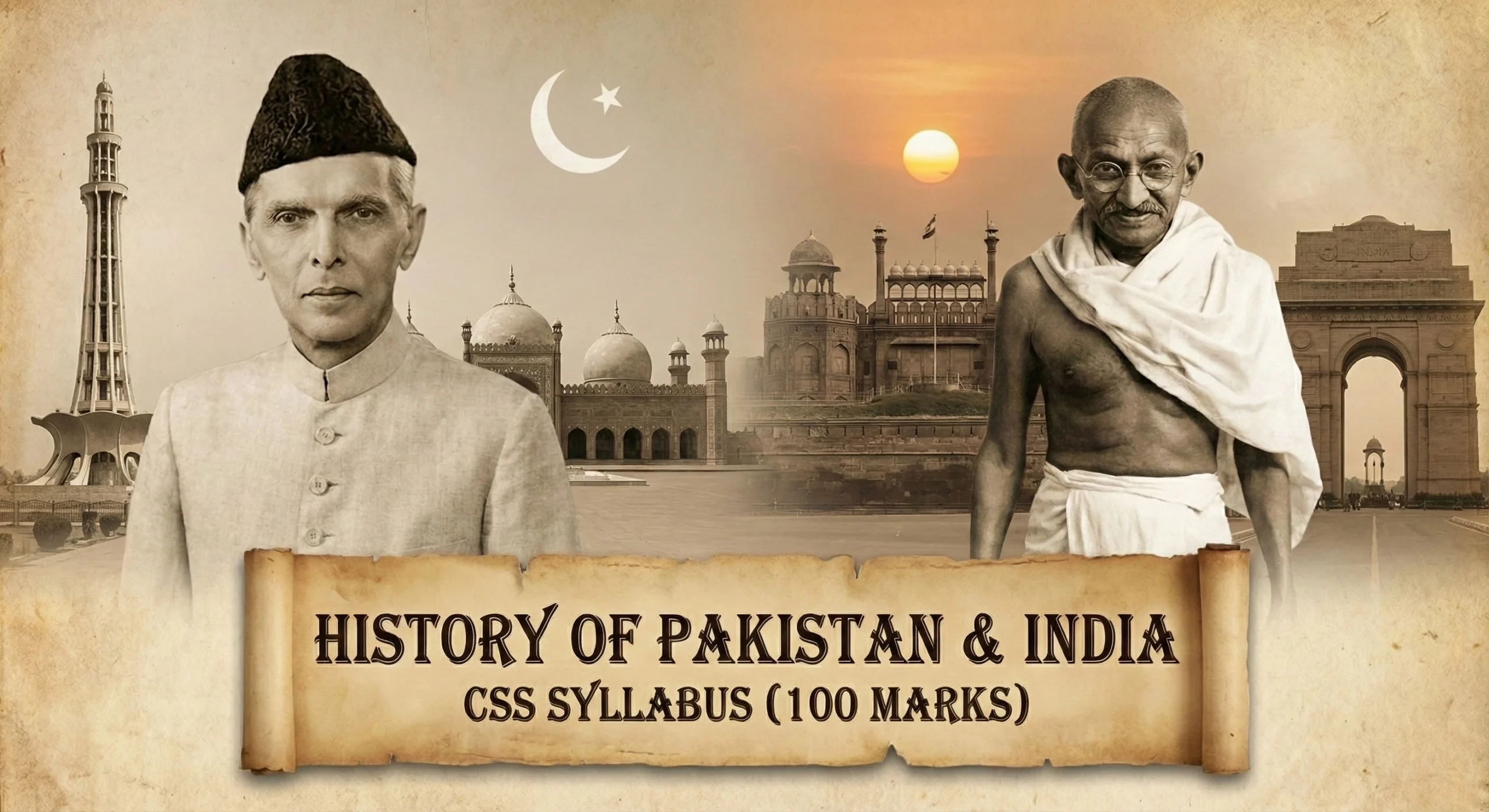
HISTORY OF PAKISTAN & INDIA CSS SYLLABUS (100 MARKS)
I. Muslim Rule and Heritage in India (712–1857)
- Political history Arrival
- Foundation and consolidation of Muslim rule in India
- Important rulers of the Slave Dynasty and the Mughals
- Spirit and legacy of Muslim civilization
- Art, architecture, and literature
- Public administration under Muslim rule
- Sultans and kings
- Economic system
- Social system
- Judicial system
- Civil administration
- Military system during Muslim rule
- Industry under Muslim patronage
- Trade and commerce
- Financial administration
II. British Rule in India (1857–1947)
- British imperialism
- Origin and growth of the East India Company
- Causes of the downfall of the Mughal Empire in India
- Effects of the downfall of the Mughal Empire
- War of Independence 1857
- Causes
- Effects
III. Constitutional and Political Reforms (1858–1947)
- Constitutional reforms introduced by the British government
- Political reforms
- Growth of political parties
- Indian National Congress
IV. Muslim Struggle for Independence
- Role of Shah Wali Ullah
- Role of Syed Ahmad Shaheed
- Role of Sir Syed Ahmed Khan towards regeneration of Muslims of South Asia
- All India Muslim League
- Partition of Bengal
- Simla Deputation
- Lucknow Pact
- Khilafat Movement
- Nehru Report
- Quaid-i-Azam’s Fourteen Points
V. Pakistan Movement
- Allama Iqbal’s Allahabad Address (1930)
- Round Table Conferences
- Congress rule in the provinces (1937–1939)
- Lahore Resolution 1940
- Various missions and plans for the partition of South Asia
- Founders of Pakistan:
- Quaid-i-Azam
- Mohsin-ul-Mulk
- Syed Amir Ali
- Ali Brothers
- Sir Aga Khan
- Chaudhry Rahmat Ali
VI. History of Pakistan (1947–To Date)
- Pakistan’s early challenges
- Quaid-i-Azam as Governor-General
- Various attempts at constitution making
VII. Military in Politics
- Ayub Khan’s regime
- Yahya Khan’s regime
- Zia-ul-Haq’s regime
- Pervez Musharraf’s regime
- Civil–military relationship in Pakistan
VIII. Separation of East Pakistan
- Causes of separation
- Effects of separation
IX. Working of Democracy in Pakistan
- Liaquat Ali Khan to Firoz Khan Noon (1947–1958)
- Zulfiqar Ali Bhutto’s period (1971–1977)
- Benazir Bhutto
- Nawaz Sharif
- Revival of democracy (1988–1999)
- Restoration of democracy (2008–to date)
- Role of major political parties
- Role of pressure groups in the history of Pakistan
X. Foreign Policy of Pakistan (1947–1999)
FPSC RECOMMENDED BOOKS List for HISTORY OF PAKISTAN & INDIA CSS SYLLABUS
| S.No. | TITLE | AUTHOR |
|---|---|---|
| 1. | POLITICAL PARTIES IN PAKISTAN: 1947-1958 | AFZAL, M. RAFIQUE, 1986 |
| 2. | GOVERNMENT & POLITICS IN PAKISTAN | AHMAD, MUSHTAQ, 1970 |
| 3. | PARTY POLITICS IN PAKISTAN: 1947-58 | AZIZ, K.K., 1976 |
| 4. | INDIA’S STRUGGLE FOR INDEPENDENCE | CHANDRE BIPIN, 1989 |
| 5. | CONSTITUTIONAL DEVELOPMENT IN PAKISTAN | CHAUDHARY, G.W., 1959 |
| 6. | WAVELL AND THE DAYS OF THE RAJ: BRITAIN’S PENULTIMATE VICEROY IN INDIA | CHAWLA, MUHAMMAD IQBAL, 2011 |
| 7. | NATIONALISM AND COMMUNAL POLITICS IN INDIA | HASSAN, MUSHIRUL, 1991 |
| 8. | THE CHARISMATIC LEADER: JINNAH AND THE CREATION OF PAKISTAN | HAYAT, SIKANDAR, 2007 |
| 9. | THE CULTURE OF POWER AND GOVERNANCE OF PAKISTAN 1947-2008 | ILHAN NIAZ, 2011 |
| 10. | MUSLIM CIVILIZATION OF INDO-PAKISTAN | IKRAM, SHAIKH MUHAMMAD, 1966 |
| 11. | PAKISTAN’S FAILURE IN NATIONAL INTEGRATION | JAHAN, ROUNAQ, 1972 |
| 12. | CONSTITUTIONAL AND POLITICAL HISTORY OF PAKISTAN | KHAN, HAMID, 2005 |
| 13. | THE MUSLIM POLITICS IN PUNJAB | QALB-I-ABID, S., 1992 |
| 14. | THE MUSLIM COMMUNITY OF THE INDO-PAK | QURESHI, ISHTIAQ HUSAIN, 1962 |
| 15. | THE STRUGGLE FOR PAKISTAN | QURESHI, ISHTIAQ HUSAIN, 1965 |
| 16. | PAKISTAN: THE FORMATIVE PHASE | SAYEED, KHALID BIN, 1968 |
| 17. | THE MILITARY AND POLITICS IN PAKISTAN 1947-86 | RIZVI, HASSAN ASKARI |
| 18. | PAKISTAN: A NEW HISTORY | TALBOT, IAN, 1999 |
| 19. | POLITICS AND THE STATE IN PAKISTAN | WASEEM, MOHAMMAD, 1989 |
| 20. | JINNAH OF PAKISTAN | WOLPERT, STANLEY, 1984 |
FPSC Official HISTORY OF PAKISTAN & INDIA CSS SYLLABUS
Here is the link to the HISTORY OF PAKISTAN & INDIA CSS SYLLABUS on the FPSC official website