PMS Age Limit Increased to 32: Punjab PMS Age Relaxation for 2026 and 2027
The PMS age limit in Punjab has received an important temporary change. Under a special two-year age relaxation announced for Provincial Management Service (PMS BS-17), candidates can now be considered up to the age of 32 years for the Combined Competitive Examinations conducted in 2026 and 2027.
For someone who crossed 30 while waiting for the next PMS cycle, that’s not a small update.
It can mean getting another chance at an exam you thought had already slipped away.
But there’s also plenty of confusion around the notification. Some websites are calculating age from the application closing date. Others are suggesting that government employees can simply add another two years to their existing 35-year limit and apply at 37.
That’s where we need to be careful.
The Punjab Public Service Commission has specific rules for calculating age in a Combined Competitive Examination, and the new relaxation shouldn’t be mixed with other concessions unless PPSC says so in the relevant advertisement.
So here’s what the new PMS age relaxation actually means, how PPSC calculates your age, who may benefit, what happens to government employees, and which details you should verify before applying.
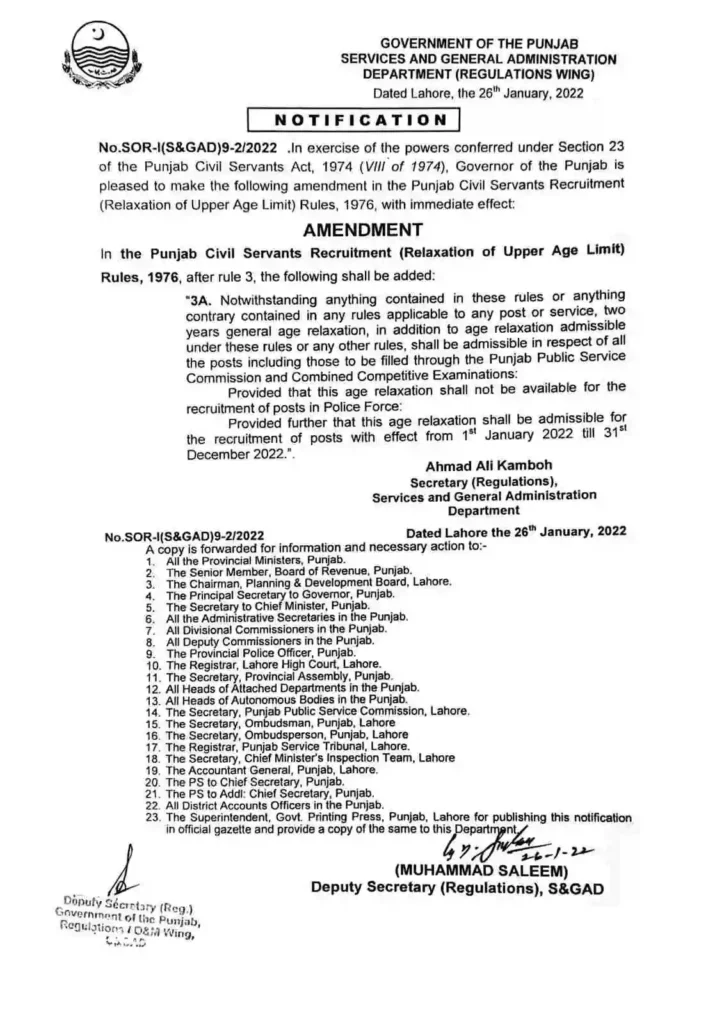
Latest update: The reported Punjab Government notification dated 19 August 2026, No. SOR-I(S&GAD)9-2/2022, provides a special two-year upper-age relaxation up to 32 years for PMS (BS-17) recruitment through Combined Competitive Examinations conducted in 2026 and 2027. Candidates should verify the final applicable conditions through the official PPSC eligibility guidelines and the Punjab S&GAD Regulations Wing when applying.
PMS Age Limit 2026 and 2027 at a Glance
| PMS Eligibility Point | Current Position |
| Normal minimum age | 21 years |
| Normal upper age limit | 30 years |
| Special PMS relaxation | 2 years |
| Upper age under special relaxation | 32 years |
| Applicable examination years | 2026 and 2027 |
| Nature of relaxation | Special one time dispensation |
| Government employees with qualifying service | Existing PPSC rule may allow up to 35 years |
| PMS attempts | 3 chances |
| PMS age calculation data | 1 January of the proposed year for examination |
The last point is particularly important.
The official PPSC FAQ on age and eligibility states that for a Competitive or Combined Competitive Examination, qualifying age is reckoned on 1 January of the year in which the examination is proposed to be held.
That is different from the normal closing-date calculation used for many ordinary PPSC posts.
What is the New PMS Age Relaxation?
The Punjab Government has introduced a special temporary concession for recruitment to Provincial Management Service (BS-17).
The change relates to the Punjab Civil Servants Recruitment (Relaxation of Upper Age Limit) Rules, 1976.
Under the special arrangement, two years are added to the ordinary PMS upper age limit, allowing eligible candidates to compete up to 32 years of age.
The concession applies to Combined Competitive Examinations conducted during:
- 2026
- 2027
The change is described as a special one-time dispensation rather than a permanent rewriting of the normal PMS age limit.
That distinction matters.
You shouldn’t assume that the PMS age limit will automatically remain 32 in 2028.
Unless the Punjab government extends the concession or changes the rules again, candidates in later examination cycles will have to follow whatever age condition appears in the relevant PPSC advertisement.
Candidates who want to follow future PMS announcements can also check our PMS Exams section for new advertisements, eligibility changes and examination updates.
Has the Punjab PMS Age Limit Permanently Increased to 32?
No.
At least not based on the wording of the present special concession.
The two year relaxation has been introduced for PMS examinations conducted during 2026 and 2027.
Think of it as a temporary window.
The door has been opened wider for two examination years, but the frame of the door hasn’t necessarily been rebuilt permanently.
So saying:
“The PMS increased age limit to 32 permanently”
Would go further than the current rule change appears to allow.
A more accurate description is:
Punjab has granted a special two-year upper-age relaxation, allowing eligible PMS BS-17 candidates to compete up to age 32 for the 2026 and 2027 examination cycles.
Candidates should continue checking the official PPSC website and the Punjab Government S&GAD notification section for later amendments.
What Is the PMS Age Cut-Off Date?
This is where several online explanations go wrong.
For normal PPSC recruitment, age is often calculated against the application closing date.
But a Combined Competitive Examination is different.
According to the PPSC official age-calculation rules:
In the case of a Competitive/Combined Competitive Examination, qualifying age is reckoned on the 1st of January of the year in which the examination is proposed to be held.
So if the Combined Competitive Examination is proposed to be held in 2026, the age reference point is:
1 January 2026
If the examination is proposed to be held in 2027, the corresponding reference point would ordinarily be:
1 January 2027
But always check the actual advertisement.
PMS exam naming can be confusing because an examination may be advertised under one year while its papers are conducted in the following calendar year.
We saw this with the recent PMS 2025 advertisement and eligibility criteria.
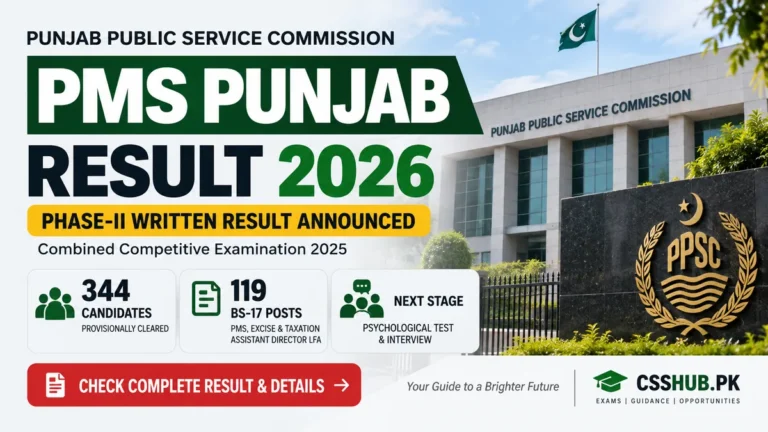
PMS/CCE-2025 was advertised in December 2025, but candidates had to meet the stated age requirement on 1 January 2026. PPSC’s official planner also records Combined Competitive Examination-2025 under Advertisement No. 47/2025. You can verify that through the official PPSC Planner.
That’s why guessing from the examination title can cause trouble.
Use the cut-off date PPSC gives you.
Does PPSC Calculate PMS Age on the Application Closing Date?
For the Combined Competitive Examination, no.
PPSC specifically distinguishes competitive examinations from ordinary recruitment.
Some explanations online tell candidates to calculate whether they are 32 years old on the application closing date.
That doesn’t match the general CCE rule published by PPSC.
According to the official PPSC FAQ, the relevant date for a Competitive or Combined Competitive Examination is 1 January of the year in which the examination is proposed to be held.
And PPSC is strict about age.
Its official guidance says that a candidate who is underage or overage even by one day isn’t eligible.
So don’t calculate your eligibility roughly.
“About 32” isn’t enough.
A single day can matter.
How Does PPSC Calculate Your Exact Age?
PPSC calculates age using the date of birth recorded in your Secondary School Certificate or another document accepted under its rules.
The official PPSC eligibility FAQ explains that the date of birth recorded on the Matriculation certificate is normally treated as final.
If a candidate appeared in an equivalent examination such as O Levels and the certificate doesn’t contain the date of birth, PPSC may require other accepted evidence such as a school-leaving certificate or CNIC.
There’s also one unusual detail worth knowing.
PPSC explains in its age-calculation example that one day is added while calculating a candidate’s age.
That means you shouldn’t simply type your birth date into a random online calculator and assume its answer will perfectly match PPSC’s method.
Use the official PPSC calculation and compare your date of birth against the precise wording in the PMS advertisement.
Who Benefits From the New 32-Year PMS Age Limit?
The biggest beneficiaries are candidates who would normally fall outside the general 21 to 30 age range but remain within the newly relaxed limit.
For example, someone who lost eligibility because the PMS examination wasn’t held when expected may now receive another opportunity.
The concession may particularly help candidates aged 30 to 32, who missed an earlier PMS cycle, candidates affected by gaps between PMS examinations, and older graduates who still have competitive examination attempts remaining.
But being within the age limit isn’t enough by itself.
You must still satisfy the other conditions in the relevant advertisement, including qualification, Punjab domicile and remaining examination chances
For a wider comparison of those requirements, read our CSS vs PMS eligibility guide.
Does the New Age Relaxation Apply to Every Post in the Combined Competitive Examination?
The reported new provision specifically refers to:
Provincial Management Service (PMS), BS-17
and describes the special relaxation in connection with recruitment to PMS through the Combined Competitive Examination.
That matters because a Punjab Combined Competitive Examination can contain other BS-17 posts alongside PMS.
For example, the recent PMS 2025 Combined Competitive Examination included:
- Provincial Management Service
- Excise and Taxation Officer
- Assistant Director Local Fund Audit
The official PPSC Planner records that examination as Case No. 36C2025 with 119 total posts.
So don’t automatically assume that every post included in a future CCE must receive the exact same special 32-year concession.
The next PPSC advertisement should settle that question.
Until then, the safer position is:
The special concession is expressly associated with recruitment to PMS (BS-17). Eligibility for any additional post included in the same CCE should be checked against the relevant PPSC advertisement.
PMS Age Limit for Government Employees
Government employees already have a separate age concession under PPSC rules.
According to the official PPSC rules for government employee age concession, the upper age limit may be 35 years for:
- Officials serving in connection with the affairs of the Punjab Government who have at least four years of qualifying service
- Officials serving in connection with the affairs of the Federal Government who are domiciled in Punjab and have at least four years of qualifying service
This provision existed before the new two-year PMS concession.
And here’s where we need to avoid doing eligibility calculations with simple addition.
Some websites may suggest:
35 + 2 = 37 years
But the available rules don’t clearly establish that result.
The new special concession describes the PMS upper-age relaxation as up to 32 years, while PPSC’s existing government-service provision gives qualifying employees a separate ceiling of 35 years.
Until the next PPSC Combined Competitive Examination advertisement explains exactly how these provisions interact, presenting 37 years as a confirmed PMS age limit for government employees would be speculation.
The safer position is:
| Candidates situation | Confirmed/general rule |
| Normal PMS upper age limit | 30 years |
| Special 2026-2027 PMS concession | Up to 32 years |
| Qualifying government employee | Up to 35 under existing PPSC rules |
| Claimed 37 year limit | Not yet confirmed by FPSC |
How Much Government Service Is Required for PMS Age Relaxation?
PPSC states that eligible government officials need at least four years of service to benefit from the government service upper age limit of 35.
For Federal Government employees, the candidate must also be domiciled in Punjab.
The official PPSC FAQ specifically explains this requirement.
So if someone has three years and eleven months of qualifying service, that isn’t the same as four years.
Close can still mean ineligible.
If you’re relying on government service to remain within the age limit, get your service history checked before the application deadline.
Do Employees of Autonomous or Semi-Government Bodies Get PMS Age Relaxation?
Not automatically.
The PPSC official eligibility guidance states that employees of semi-government bodies, autonomous bodies of the Federal Government and local bodies aren’t entitled to age concession merely for the period of their service in those organizations.
This is worth checking before assuming that “government owned” automatically means “government servant” for PMS eligibility.
If you work for a university, authority, corporation, board or another public-sector body, verify the legal status of your organization rather than relying on its name.
Do Punjab Government Contract Employees Receive Age Relaxation?
PPSC has a separate rule for qualifying Punjab Government contract service.
According to the official PPSC contract employee age-relaxation guidance, where a person has served under the Punjab Government on a contract or regular basis, that service period may be excluded for the purpose of calculating upper age.
However, there is an important ceiling.
For recruitment through the Combined Competitive Examination, the upper age limit under this provision cannot exceed 35 years.
Again, this is why simply saying:
“32 plus every other relaxation”
Isn’t a safe way to calculate PMS eligibility.
The rules contain ceiling and specific conditions.
Do Ad-Hoc Employees Get PMS Age Relaxation?
This is another important exception.
Punjab Government employees working continuously on an ad-hoc basis can receive service-related concessions for many ordinary PPSC posts.
But PPSC specifically excludes the Combined Competitive Examination from that ad-hoc concession.
The official PPSC FAQ on ad-hoc employees states that continuous ad-hoc service may be deducted from age for other posts, except Combined Competitive Examination and Civil Judges-cum-Judicial Magistrates.
So, if someone tells you:
“Just subtract your entire ad-hoc service from your age for PMS.”
That isn’t what the published PPSC guidance says.
What About Candidates With Disabilities?
Candidates with disabilities should check the exact relation and quota conditions appearing in the applicable PMS advertisement.
PPSC maintains separate requirements for candidates applying under the Special Persons quota.
According to the official PPSC Special Persons eligibility guidance, a candidate seeking consideration under the Special Persons quota must be properly registered and provide the required disability certification through the competent authority.
PPSC also provides additional examination time to qualifying candidates who require a reader or writer in a Combined Competitive Examination.
What shouldn’t be done is automatically add every possible concession together and publish a maximum age without the relevant PPSC advertisement supporting the calculation.
The exact age treatment for special persons in the next PMS/CCE should therefore be verified from that advertisement.
How Many PMS Attempts are Allowed?
The new age relaxation change concerns the age window.
It shouldn’t be confused with the number of competitive examination changes.
FPSC has historically limited candidates in the Combined Competitive Examination to three chances, subject to the applicable examination rules.
So an age extension gives you more time to remain eligible.
It doesn’t automatically reset examinations you have already attempted.
If you have already appeared in previous PMS cycles, verify your own attempt history before applying.
PMS 2026 vs PMS 2027 Age Limit
The temporary concession covers PMS Combined Competitive Examinations conducted during 2026 and 2027.
| Examination Year | Special PMS upper age limit | Normal Upper age limit | General CCE age reference |
| Examination 2026 | Up to 32 years | 30 years | 1 January 2026 |
| Examination 2027 | Up to 32 years | 30 years | 1 January 2027 |
This should still be checked against the actual advertisement.
PMS naming can create confusion because the competition title and the calendar year in which papers are held may differ.
Our PMS 2025 advertisement guide is a useful example: CCE-2025 used 1 January 2026 as its relevant age reference.
Practical PMS Age Limit Examples
“I’m 31 and have never worked for the government.”
Under the special 2026–2027 PMS concession, you may fall within the 32-year upper limit, provided your exact age on the relevant PPSC cut-off date and all other eligibility requirements are satisfied.
“I’m exactly 32 years old.”
Possibly.
But your exact date of birth matters because PPSC calculates age precisely and says that a candidate who is over average by even one day is ineligible.
Use the correct 1 January reference date.
“I’m 33 and work for a private company.”
Private employment doesn’t provide the government-service concession.
Under the special general PMS provision, the upper limit is 32.
“I’m 33 and have five years of Punjab Government service.”
The existing PPSC government-service rule may allow an upper-age limit of 35, provided your service qualifies and the relevant advertisement allows the concession.
“I’m 36 and have six years of Punjab Government service.”
The current PPSC FAQ places the government-employee Combined Competitive Examination ceiling at 35.
Don’t assume the new two-year PMS concession raises it to 37 unless PPSC expressly confirms that treatment.
“I work for an autonomous government organization.”
That doesn’t automatically give you the same concession as a qualifying Punjab Government employee.
Check the organization’s legal status and the relevant PPSC rule.
“I’m 31 but I have already exhausted my permitted PMS chances.”
An age relaxation doesn’t automatically create an additional examination attempt.
Age eligibility and attempted eligibility are separate issues.
Does the New PMS Age Limit Apply to Men and Women?
The special PMS concession concerns recruitment to PMS (BS-17) rather than creating separate new upper limits for men and women.
Recent PPSC Combined Competitive Examinations have allowed eligible:
- Male candidates
- Female candidates
- Transgender candidates
Subject to the qualifications, domicile, age and other conditions stated in the relevant advertisement.
Candidates should always check the final PPSC jobs and advertisements section because the advertisement is where the practical eligibility conditions for a particular examination are set out.
Is Punjab Domicile Required for PMS?
Punjab PMS is a provincial competitive examination, and Punjab domicile is required under recent PPSC Combined Competitive Examination advertisements.
This is one of the fundamental differences between PMS and CSS.
CSS is conducted federally through FPSC and uses a federal quota system.
Punjab PMS is conducted through PPSC for eligible Punjab-domiciled candidates.
If you’re deciding between the two examinations, our CSS vs PMS comparison explains the differences in age, domicile, attempts, syllabus, job allocation and examination structure.
PMS Age Limit vs CSS Age Limit
Candidates sometimes mix these two systems together.
You can read the complete CSS vs PMS comparison if you’re considering both examinations.
CSS candidates should also remember that their age system works differently. The current CSS process uses 31 December of the preceding year as the eligibility cut-off, rather than Punjab PMS’s CCE rule based on 1 January of the examination year.
Why Did Punjab Introduce the Two-Year PMS Relaxation?
The practical reason is easy to understand.
PMS examinations aren’t always held on a perfectly predictable annual schedule.
A candidate can spend years preparing, waiting for vacancies and watching examination cycles move around.
Someone who was comfortably within the age limit when preparation began can find themselves overage by the time another opportunity appears.
Punjab has used temporary changes to its upper-age-limit rules before. The official S&GAD Regulations Wing records previous amendments to the Punjab Civil Servants Recruitment (Relaxation of Upper Age Limit) Rules, 1976.
The present special concession gives candidates affected by the examination cycle another window to compete.
But it’s still a limited window.
That’s why someone who becomes eligible again shouldn’t treat the extra time as a reason to wait.
What Should You Do If the New Relaxation Makes You Eligible Again?
First, don’t start by buying five new books.
Start with your eligibility.
Check your exact age according to the PPSC Combined Competitive Examination rule.
Then check your Punjab domicile, educational documents and previous examination history.
Government employees relying on the 35-year provision should verify their qualifying service and employment status carefully.
After that, study the recent examination structure through our PMS 2025 complete guide and follow future announcements through the CSS Hub PMS Exams section.
And when the new advertisement arrives, compare everything against the official PPSC website before submitting your application.
Important PMS Age-Limit Mistakes to Avoid
Calculating age on the application closing date
For a Punjab Combined Competitive Examination, PPSC says qualifying age is reckoned on 1 January of the year the examination is proposed to be held.
Assuming 32 is permanent
The new concession is connected to the 2026–2027 PMS window.
Adding every age relaxation together
Don’t turn 35 into 37 simply through arithmetic unless PPSC explicitly confirms that interpretation.
Assuming every CCE post automatically receives the concession
The special wording specifically concerns PMS (BS-17). Check the next advertisement for other posts.
Assuming ad-hoc government service automatically gives PMS relaxation
PPSC specifically excludes the Combined Competitive Examination from its ordinary ad-hoc service concession.
Trusting screenshots instead of official sources
Always check the PPSC official website, the PPSC eligibility FAQ and the Punjab S&GAD Regulations Wing when the rule affects whether you can sit the examination.
Frequently Asked Questions – PMS Age Limit
What is the PMS age limit in Punjab?
The normal Punjab PMS age range has generally been 21 to 30 years. A special two-year relaxation has been reported for PMS BS-17 recruitment through Combined Competitive Examinations conducted in 2026 and 2027, allowing eligible candidates up to 32 years.
Has the PMS age limit increased to 32?
The special 2026–2027 PMS concession increases the upper limit by two years, up to 32, for the examination window covered by the rule.
Is the PMS age limit permanently 32?
No. The present concession is temporary unless Punjab later extends or permanently changes the applicable rules.
What is the PMS age limit for 2026?
Under the special concession, eligible PMS BS-17 candidates may be considered up to the age of 32, subject to the exact conditions in the PPSC advertisement.
What is the PMS age limit for 2027?
The temporary two-year concession also covers PMS recruitment conducted during 2027, subject to the applicable PPSC advertisement.
On which date is PMS age calculated?
According to the official PPSC FAQ, qualifying age for a Competitive or Combined Competitive Examination is reckoned on 1 January of the year in which the examination is proposed to be held.
Is PMS age calculated on the application closing date?
Not under PPSC’s published Combined Competitive Examination rule. The CCE uses the 1 January examination-year reference date.
Can a 31-year-old apply for Punjab PMS?
Under the special 2026–2027 concession, a 31-year-old may fall within the permitted age range, subject to their exact date of birth and other eligibility conditions.
Can a 32-year-old apply for PMS?
Potentially, yes. But exact age matters because PPSC states that being overage even by one day makes a candidate ineligible.
What is the PMS age limit for government employees?
According to the PPSC government employee eligibility rules, qualifying Punjab Government employees and Federal Government employees domiciled in Punjab with at least four years of qualifying service may have an upper-age limit of 35 years.
Does the new two-year relaxation make the government employee limit 37?
That isn’t confirmed by the currently published PPSC guidance. The special PMS concession goes up to 32, while the existing qualifying government-employee CCE ceiling is 35. Candidates should not assume the limits stack unless PPSC expressly says so.
Do Punjab Government contract employees receive age relaxation?
PPSC says qualifying contract or regular service under the Punjab Government may be excluded when calculating age, subject to the relevant rules. For the Combined Competitive Examination, the upper age under that provision cannot exceed 35 years.
Do ad-hoc Punjab Government employees get PMS age relaxation?
PPSC specifically states that its normal ad-hoc-service concession does not apply to the Combined Competitive Examination.
Do employees of autonomous bodies receive PMS age relaxation?
Not automatically. PPSC distinguishes qualifying government service from employment in semi-government, autonomous and local bodies.
How many PMS attempts are allowed?
Candidates should check the applicable competitive-examination rules and their previous examination record. The age concession itself doesn’t create additional attempts.
Does the new age-relaxation notification give candidates extra attempts?
No additional attempts are created merely because the upper-age limit has been relaxed.
Does the new relaxation automatically apply to ETO and Assistant Director Local Fund Audit?
The special wording concerns PMS (BS-17). Other posts included in a Combined Competitive Examination should be checked against the relevant PPSC advertisement.
Final Words – PMS Age Limit
For candidates who watched the PMS age window close while waiting for another examination cycle, this is a meaningful change.
The PMS age limit has effectively been given an additional two-year window, up to 32 years, for the special 2026 and 2027 PMS BS-17 recruitment period.
But don’t let a good announcement turn into bad eligibility advice.
Remember the details that actually matter.
PPSC calculates Combined Competitive Examination age on 1 January of the year in which the examination is proposed to be held.
The new 32-year concession is temporary.
It doesn’t mean every other age concession can automatically be added on top.
And the next PPSC advertisement remains essential because it will tell you exactly how the rules apply to that examination cycle.
If this relaxation puts you back inside the age window, check your documents and eligibility now.
Then get back to studying.
Because getting two extra years on paper feels huge when you thought the door had closed.
But once you walk through that door, you still have to pass the exam.